

Content verified by

What is AMD?
AMD is a common eye disease that affects your central vision, changing how you see things directly in front of you.
AMD occurs in your macula, the centre of your retina (back of your eye). The retina controls your central vision by converting images into electrical signals and sending them to your brain. However, as you age, your macula can degrade, affecting your retina and changing your vision.
Our expert ophthalmologists at St Thomas’ Hospital provide dedicated support for all types of AMD so you can find relief and protect your vision from deteriorating further.
Experts in protecting your vision
Our ophthalmology specialists offer personalised private care, including:
- Short-notice appointments
- Fast and accurate diagnosis
- Fast access to treatment

AMD does not usually cause total blindness, but it can make reading and recognising faces a challenge. Without treatment, AMD can worsen and cause further vision problems.
AMD can occur alongside other eye conditions, like glaucoma, where your optic nerve becomes damaged and causes vision loss.
Who is at risk of AMD?
AMD is more likely to occur as you age but some people can develop it sooner due to several factors.
The main risk factors for AMD include:
- a family history of AMD
- being overweight
- eating a diet high in saturated fats
- hypertension (high blood pressure)
- smoking
Types of AMD
When diagnosing AMD, our specialists typically categorise it into a type and a stage. There are 2 types and 3 stages of AMD.
The 2 types of AMD are:
- dry – most cases of AMD are the dry type, which occurs when small protein deposits form under your macula, causing it to thin and dry
- wet – a less common type where abnormal blood vessels develop under your retina and macula and leak fluid, causing the macula to bulge and affect your vision
The 3 stages of AMD are:
- early – changes to your macula occur, but your vision stays the same
- intermediate – your vision is blurry or wavy
- advanced – your central vision is entirely black
Wet AMD is always advanced, whereas dry AMD can be early, intermediate or advanced.
Dry AMD can progress into wet AMD, but wet AMD cannot change to dry.
Our eye care specialists at St Thomas’ Hospital provide tailored treatment plans to patients with AMD. Complete our online enquiry form to book your appointment.
Symptoms of AMD
AMD can develop in one or both eyes. The first symptoms of AMD are often blurred or distorted vision and, as the condition progresses, you may see dark patches or spots in your central vision.
Other symptoms of AMD can include:
- flickering or flashes of light in your vision
- straight lines appearing wavy or crooked
What causes AMD?
The underlying cause of AMD is unknown but experts think it runs in families. However, people without a family history of AMD can also develop the condition. Doctors believe AMD may develop due to a combination of risk factors like genetics, smoking, diet and being overweight.
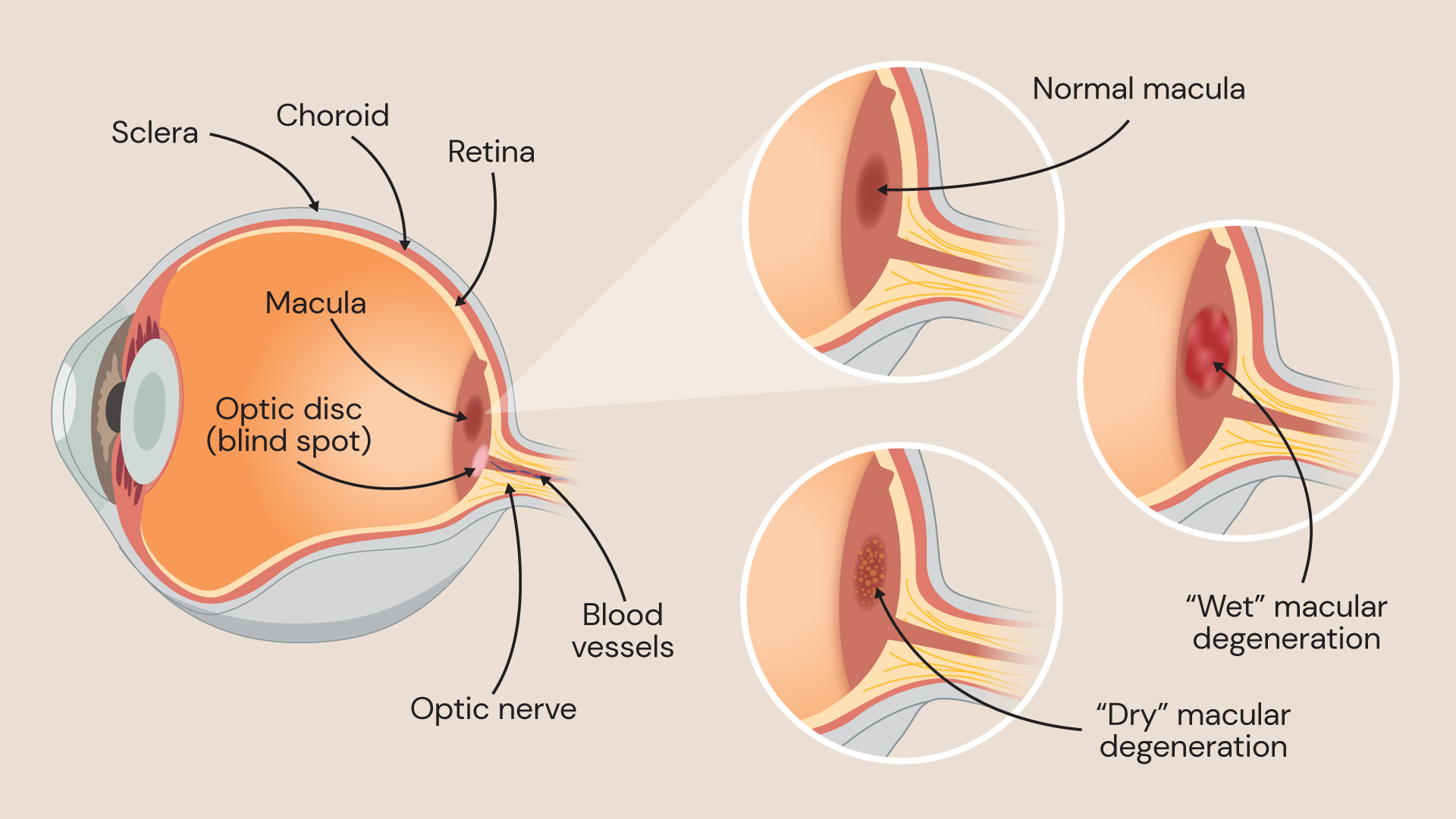
Diagram of the eye highlighting the macula and optic nerve, alongside examples of a normal macula and the characteristic changes seen in wet and dry age-related macular degeneration (AMD).
Complications of AMD
Untreated AMD can worsen and cause even more changes to your vision. Dry AMD that progresses to wet AMD can quickly lead to complete vision loss, so treatment is essential.
Another potential complication of AMD is Charles Bonnet syndrome, where you experience visual hallucinations because of your vision changes.
However, our team will ensure prompt treatment to minimise your risk of AMD complications.
If you’re experiencing symptoms of AMD, don’t hesitate to contact our team who can book you an appointment with one of our consultants.
Diagnosing AMD
Diagnosing AMD relies on discussing your symptoms and performing an eye examination to look at your retina and macula.
Some of the tests we may perform include:
- Amsler grid test – we’ll ask you to look at a grid with a dot in the centre with one eye covered. Any of the lines appearing distorted can suggest macular degeneration
- dilated eye examination – eye drops dilate your pupils (the black dot in the centre of your eye), so we examine the back of your eye with a special lens
- fluorescein angiography – we inject a dye called fluorescein into a vein in your arm, which will move through your blood vessels so we can check those in your eye for signs of wet AMD
- OCT angiography – a special scanning machine that takes 3D images of your eye to check for AMD signs
- optical coherence tomography (OCT) scan – this imaging scan takes detailed pictures of the back of your eye while you look into a special camera. This test is quick and provides instant results to decide if you require treatment.
AMD treatment
While AMD cannot be cured, its progression can be slowed, and your symptoms can be improved. The suitable treatment for you will depend on your type of AMD. Our ophthalmology services can help you receive personalised care that meets your needs.
We may treat wet AMD with intravitreal injections that contain anti-vascular endothelial growth factor (anti-VEGF). These injections stop the production of VEGF, the protein that creates new blood vessels, which should halt its progression.
Anti-VEGF injections are given directly into the eye, but we’ll ensure it’s numb beforehand so you won’t feel any pain.
Dry AMD treatment typically involves managing your symptoms and learning how to live with the condition. In some cases, we will recommend vitamin supplements to slow the progression of AMD.
If your vision is affected, we can advise you on enhancing it in ways like:
- adapting your phone or computer to make it simpler to see
- changing the lighting in your home to be brighter
- using a magnifying glass
We may also recommend staying as healthy as possible by:
- eating a well-balanced diet
- exercising regularly
- losing weight if you’re overweight
- stopping smoking
- Vitamin supplements
Our specialists can also advise whether it’s safe if you’re worried about driving with AMD.
You’ll also need to attend regular check-ups so we can monitor your condition and ensure any changes to your vision are treated as soon as possible.
Contact our team to discuss your treatment options for AMD. We can book you an appointment with our consultants, who will create a personalised AMD treatment plan for you.
Reviewed regularly to reflect clinical best practice
Last reviewed: 07 April 2026
Locations
Our private ophthalmology service is available at:
Discover our ophthalmology specialists